Thursday, 20 March 2008

Self-Interview about Self-Publishing


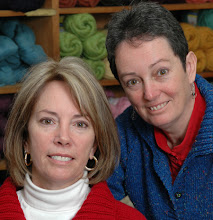
March 19, location - downtown Toronto, DKC knitting guild (http://www.downtownknitcollective.ca/) , present - many knitters knitting, Lynda and I speaking on Self-Publishing.

I put myself in the position of the knitting audience and asked ourselves questions that I thought they might be interested in. We did a Self-Interview on Self-Publishing. You might recognize a theme here - self, self, self. We DO like to do things ourselves. At least we thought so until we asked ourselves "How many people were involved in making the Button Up Your Top Down book?" - an astounding 22 !! - 6 of us doing the designs, a photographer, our contact at the printers, a friend doing the copy edit, several models, 2 pattern checkers, another friend wrote some style text, a graphic artist did the cover, several test knitters and ... I'm sure I'm forgetting someone. Anyway a big crew and now I look back I'm not sure how it all came together but it did.
I do remember moments, like choosing the cover. We had the basic style set and had to choose between 4 different colourways. So we pinned them to the wall and 3 of us are stood with our eyes closed, open your eyes, which one do you see first? Change them up, eyes closed, open and which one jumps out? We all agreed, Done.


I have spoken now at the DKC 3 times, a friendly and very active guild. It's a joy to go there because of all the familiar faces and of course each time meeting some new knitters.
If you are in the Toronto area at the end of April come to the guild's Knitter's Frolic (see their website above) it's a terrific show, lots of vendors and a great line-up of classes. We'll be there as vendors and teaching.

"Lynda, What is the trickiest part of doing a book like the Button Up Your Top Down? - The layout.
What's the most work? - The layout.
What's the most fun? - The layout.

The knitters continuing to do their thing.

Rocky brought her Top Down pullover from the Top Down For Toddler book. And look, it has 3 tiny pockets (you can just see the yellow lining of the pockets). Wow, what a great addition. I love it.
I'm off for the weekend. My husband and I are celebrating our silver anniversary with some time away and some time at the curling rink too as our daughter is playing in the Tim Horton's Trophy Provincial championships. Fun for us to watch her doing what she loves to do. I am of course taking my knitting, it's second sock weekend, being as it's a celebration of coupledom.
- Deb

Friday, 14 March 2008

The Process Continues

I have been writing out my basic construction of this Top Down Baby V-neck cardigan for a week. This chart is the final outcome. I love this part. I love fiddling with the numbers and getting the sizing to work out and checking with other baby books for sizing and fit. The challenge for myself is to work out the neck shaping so that it's simple and elegant. It goes from something in my head, onto the paper, and sometime this weekend it will morph into something, some day, you will be able to knit.


This is where I start. This is a V-neck cardigan in 5 sizes from Preemie to 18 months. Each of the circles are needles with numbers of stitches on them. I start with the cast on and then a circle for the number of stitches at the bottom of the V shaping, again at the Divide For Body and Sleeve Row, and then 2 circles for the number of stitches on the Body needle and the sleeve needle. It's very straight forward and I can write my pattern from this format. I have spent most of the afternoon making a rough pattern like this. It has lots of ??? and red lines where I have to fill in more numbers. But it's starting it's transformation.

Now that I have a rough pattern written up I begin, yes you won't believe it, another sample! I follow along and try to fill in the holes I've left in the pattern. Mostly all the final bits, number of sleeve stitches for the cuff, final length, number of buttonholes, etc.

This pattern will then go to several designers (Friends of Cabin Fever) and they will take it and have their way with it. Me too. That's when the fun begins with pattern dictionaries, ideas you had in the back of your head, some design dredged up from memory that was appealing.
But I'm getting ahead of myself. There are the still the details to work out. Do the buttonholes look too far apart to you? I better just keep going, agonizing over the smallest of details sets in just about here and then someone will have to wrestle this away from me. When the sample is done I have one more chance to make some final decisions. I have a weekend deadline, I have to give the designers time to do their thing.
Back to the sample,
- Deb

Thursday, 13 March 2008

Same Old, New Colour

I got tired of the yellow baby yokes and have now switch it up to gold. I think I am finally ready to write out the pattern but there is one final check in the works and I'm awaiting news. I gave my last yellow yoke, which I have sized at 6-9 months old, to Dana who has a customer at the yarn store she works at (Sheep Strings in Huntsville, ON) with an 8 month old baby. There will be a fitting this week. We want to check the neck opening which Dana suspects it's a little too small. I can adjust, I'm just waiting for the word. I am very, very tired of yellow yokes. I should have more stamina, I only knit about 8 of them, so here it is in gold.
Yes, I love the colour. Does this neck look too small for an 8 month old neck? (I think it looks a little bigger in the photo than real life, hmmm.)
-Deb

Sunday, 9 March 2008

Ah, ha Moment


I think I have had an ah-ha moment. Do I trust it? I have been wrestling with the problem of stopping the stretch at the back of the neck. When you start a Top Down at the collar (like I do) it has no cast off at the back of the neck to stablize this spot which takes quite a lot of the strain when you wear a sweater. Every construction has a weak point and I think this is one for this type of Top Down.
We have done various things in different patterns for coping with this. With a fold-over collar you can decrease across the back of the neck and then increase back up again, or you can work a large collar with many stitches cast on at the outside edge and decrease down at the back of the neck. Both of these work really well. But for the small ribbed neckband this does not seem to work. I am also working on a mock turtleneck pullover with a k1,p1 rib and this doesn't work too well on that either. But ...

This is an adaptation of a slip stitch pattern which I had a vague memory of (I will have to try to find it in a book). You increase and then pass a slipped stitch over, but if you don't slip the stitch but knit it, it gives me a non-stretchy line which mimics a purl ridge. I think I got it !! Tomorrow I may wake up and realize I have totally missed something but for the moment I am happy, happy.


-Deb

Friday, 7 March 2008

Votes Are In

The votes are 3:1 for the more complex instructions/better looking v.s. simple instructions/some distortion.


Ann wrote "I would vote for the more complex directions that result in a neater finish – and I feel that way whether the sweater be pint sized or enormous! I think that one of the attractions of so many of your patterns is the very “clean” lines one achieves by not having seams in the usual places. Any shaping within the piece needs to reflect that precision, and where stocking stitch is being used, this is even more important, as there is no flexibility for “hiding” increases or decreases by careful placement within the stitch pattern."


SuEllyn wrote "I vote for the second one because it’s not much more complicated and looks really good. If I only had the first choice available I would work it through because it doesn’t look bad, just not as good."


From Sascha (who regularly leaves a comment, thanks for that) "I like the look of the second method of decreasing. For me it wouldn't make a lot of difference in keeping track, as I just write it all out, circling the dec rows and check them off. I'd do that with either method. I just like the look better on the sweater using the second way."


Ann also tagged on "Also, the inclusion of a little spice in the form of a more challenging technique, especially one that is only worked for a relatively small part of the overall process, would be appealing to many knitters."


Yay Ann, I'm also that kind of knitter or I wouldn't be pushing the Top Down construction to see what it can do. But simpler instructions let a lot more knitters into the process.


Heather wrote "I don’t mind the distortion at all, I actually kind of like it. So I vote for distortion + simpler directions."


As a designer these are important questions for me. I want to let lots of knitters of different experience levels into what I do. And trying to work things out the easiest and most logical fashion is a continuing challenge. This is not 'dumbing down'!! This is doing things as straight forwardly as possible and not using complexity just because I can which is a poor excuse for not giving it enough thought to find the easier way. I'm also looking for a 'good bang for the buck' as they say. If I use something more complex I want to know that the result is worth the trouble of doing it.


I now have a plan. After talking to my friend and fellow designer, Bernice (www.mommabearknits2.blogspot.com), I finally worked out that I actually have 2 Baby sweater booklets worth of knitting here. I am going to work one booklet in a simpler fashion with a shallow V (below) which I used in the Button Up Your Top Down book. I'm going to include both cardigans and pullovers.
The second booklet will have the complex directions with the deeper V for the more advanced knitter looking for something different. Something like these.

I am going to work the booklets in the same fashion as the books - write out basic patterns, give them to Cabin Fever designers and let them have fun with them. This is a long road so don't expect anything soon. I'm hoping one booklet will be done for June/08. I'm so happy to have a plan. Lots of baby things to knit, yes, yes, yes!


Thanks for all the comments. I really appreciate the input. It helps me settle things in my head and also gives me a feeling of who I am designing for - You.
- Deb

Monday, 3 March 2008

Down to Two


I have got the V-neck down to 2 samples. They look more or less the same. They give me a deep V which I was looking for and both have the correct number of stitches I needed. In order to get the correct number of stitches on each of the Fronts I had to decrease 4 sts on each of the Fronts while I worked the Short Rows. Below are 2 versions of the decreases worked over a different length of rows.
In the photo above you can see that along the shapeline on the left (shapeline is the 2 sts between the pairs of increases which make the diagonal raglan line) that there is distortion, sort of cupping, because I worked the decreases quickly. One decrease was worked every 2 rows, repeated 4 times (decreases worked over 8 rows total) which decreased the 4 sts needed. The rest of the V (16 rows) is worked with an easier set of 2 rows repeated 8 times until the end of the V.
This photo shows the decrease of 4 sts but it's worked with 4 rows repeated 4 times (16 rows total). More complicated to keep track of but less distortion. The rest of the V (only 8 rows left) is worked with the easier set of 2 rows repeated 4 times to the end of the V.
This will be an Intermediate Experience Level pattern.
My two questions here are:
1) Can you accept some distortion for a method that is easier to work OR do you want a more perfect outcome even if it means working more complex directions?
2) If this was an adult sweater would your answer be different? (You would be decreasing about 10 - 12 sts instead of the 4 sts of the baby sweater.)
Leave a Comment or contact me at my email deb.cabinfever@gmail.com . I am extremely interested in your answers. I have a bias myself but I'll wait until I hear from you.
- Deb

Sunday, 2 March 2008

We're Working Small

Bernice and I are both working on baby sweaters and if you want to check out an upcoming Cabin Fever pattern in the making check out http://mommabearknits2.blogspot.com and see how it's coming along.

I have been working too but not taking any photos. Sometimes you just get going and don't think about stopping especially when I am trying to puzzle out a problem. Totally engaging to me but not extrememly interesting to too many others.

So here is the work to date, several days work in fact. Doesn't look like much does it! All those baby sweaters started and not one finished (and not bound to be finished ever). I know this bugs the *&^% out of some knitters but the process must go on just like this a little longer. I am almost there. It's so very close now.


I have a short V worked out. More or less the depth a crew neck would be. Ignore how narrow the back of the neck is. I somehow ended up with 4 stitches less than I intended to put on. How does this happen anyway? I'm sure I counted, well almost sure.
And the deeper V is coming along. I cast on all of the stitches for the deeper V of the ribbing but then I have too many stitches on each of the Fronts so I have to get rid of 4 sts as I work down the V using short rows. What if I just don't work 4 of the increases at the raglan shapeline? (The shapeline is the 2 sts between the pair of increases which make the diagonal line.) I like this approach but my designer team was not enthusiatic.
I tried working the extra decreases next to the V of the ribbing, and then I tried them next to the YO increases. How about if I decrease inside the shapeline stitches? I tried decreasing every Right Side row for 4 times and every other Right Side row over 8 RS rows and then I tried working SSKs where I had been working K2togs....
No blogging takes place during this period mostly because I am just the tiniest bit frustrated as the pile of baby yokes gets higher and higher and I still don't have what I want (I ripped out the ones which were definitely not going to work out). But ... I think now there is a light at the end of the tunnel and I may have got something that I am happy with.
This is the gleeful time. It's not the end but a major problem solved is a great feeling. I may read a book this afternoon to celebrate.
-Deb