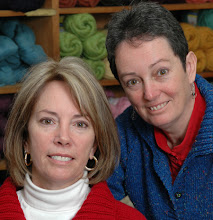
Here we are in Arlington,VA across the river from Washington, DC. We setting up at The National Needlework Assoc Show tomorrow and will spend the weekend talking to Store Owners who have come to shop. Our flight was uneventful, except for being picked out of the security line to have all my belonging searched and to have a very lovely security woman give me a pat down or a gentle all-over massage as she called it, ha, ha. Nothing in my shoes, nothing on my hands, nothing in my suitcases, good to go.
I started my new socks again, having for some strange reason decided to make this particular pair an inch too small. Rip, rip, rip. The good news is that I am much bettter with these needles after knitting part of a sock.
These are Neko needles. It's very much like knitting with 2 circular needles. The needles are plastic and very flexible so I'm finding them fairly easy to use. The curve fits in your hand and the trick seems to be how to hold them so the ends of the needles don't impede progress.
Progress is being made. Yay. They are pretty interesting to knit with. I wonder if I got a larger set, if they would be good for knitting sleeves? They definitely have possibilities.
I got these needles from Tracy at A River of Yarn in Canada.
Deb
Thursday, 9 June 2016
Monday, 6 June 2016
Mosaic boxes
It's the end of our Knitting Guild year. Yesterday we spent it at Linda's house learning to knit Mosaic boxes and V-neck Top Down knitting. It was a great day. Here we are, knitters hard at work, ha, ha.
Really we were learning how to read a mosaic chart. They are different from other charts.
Mosaic is colour knitting, working with only 1 colour across the row at a time. You knit the stitches you want to show in the particular colour you're working with and slip all the other sts. It's often found in your stitch dictionary in the Slip Stitch section.
Each row of the chart requires two passes (rows) of the same colour. With the Light Colour work the first row of the chart two times (Rows 1 & 2), once with the Right Side facing and back again on the Wrong Side. Now move to the second row of the chart and with the Dark Colour work it across on the Right Side and back again on the Wrong Side (Rows 3 & 4). Every row of the chart is worked twice with the same colour. Then the next row of the chart is worked twice with the next colour, alternating 2 rows Light and 2 rows Dark. It makes mosaic charts different from any other type of chart. Geometric designs result. The different colours make it look different.
Boo, hoo, that's it for Guild nights for a while. I'm going to miss my knitting buddies over the summer. Looking forward to seeing everyone in September.
Deb
Really we were learning how to read a mosaic chart. They are different from other charts.
Mosaic is colour knitting, working with only 1 colour across the row at a time. You knit the stitches you want to show in the particular colour you're working with and slip all the other sts. It's often found in your stitch dictionary in the Slip Stitch section.
Each row of the chart requires two passes (rows) of the same colour. With the Light Colour work the first row of the chart two times (Rows 1 & 2), once with the Right Side facing and back again on the Wrong Side. Now move to the second row of the chart and with the Dark Colour work it across on the Right Side and back again on the Wrong Side (Rows 3 & 4). Every row of the chart is worked twice with the same colour. Then the next row of the chart is worked twice with the next colour, alternating 2 rows Light and 2 rows Dark. It makes mosaic charts different from any other type of chart. Geometric designs result. The different colours make it look different.
These two below, have the colours reversed. The boxes are Light and the Background is Dark. To read the chart above and switch the light and dark is a real challenge and K & T did a terrific job.
Deb
Thursday, 2 June 2016
Add Mosaic
Adding a little bit of Mosaic to this vest really makes it look different. Can't wait until the class I'm teaching on Sunday gets started so I can see how it looks in different colours. I did it in Cotton Tweed Denim with Sky Blue. It would look more dramatic with a greater contrast between the colours.
As you know, blue is my go-to colour. But I'm going to see what other colours I can choose to make more impact. The vests in the class will give me some good ideas I bet. Now I'm going button shoping. Always an adventure.
-Deb
As you know, blue is my go-to colour. But I'm going to see what other colours I can choose to make more impact. The vests in the class will give me some good ideas I bet. Now I'm going button shoping. Always an adventure.
-Deb
Saturday, 28 May 2016
Mosaic collar or neckband?
I have been knitting, just not writing about it, for the last couple of weeks. Now I'm back and working out a Mosaic Top Down Vest workshop to present to my knitting guild in 2 weeks.
I started out being too ambitious as usual. I thought of working a Mosaic collar on a Top Down V-neck baby vest. It's all doable but not for the time allowed for the class. The Mosaic pattern is 18 rows deep and then there are rows to knit so the collar can flip over nicely. Way too much time would be spent on the collar and not enough time on the rest of the Top Down garment. I really like how it looks though. Might be worth writing up as a pattern?
I'm calling this pattern "little boxes". One box is solid and the box beside it has a centre dot. At one point you have to slip 3 sts which is good training for mosaic knitting. It's all about the slips.
Now onto the V-neck portion of the garment.
-Deb
I started out being too ambitious as usual. I thought of working a Mosaic collar on a Top Down V-neck baby vest. It's all doable but not for the time allowed for the class. The Mosaic pattern is 18 rows deep and then there are rows to knit so the collar can flip over nicely. Way too much time would be spent on the collar and not enough time on the rest of the Top Down garment. I really like how it looks though. Might be worth writing up as a pattern?
Back to the drawing board.
I've decided a Neckband for a V-neck vest would be much more practical for the Mosaic portion of the class. Only 10 rows are involved in this mosaic pattern. That's manageable. Everyone will still learn how to read a mosaic chart which does take some practice.I'm calling this pattern "little boxes". One box is solid and the box beside it has a centre dot. At one point you have to slip 3 sts which is good training for mosaic knitting. It's all about the slips.
Now onto the V-neck portion of the garment.
-Deb
Thursday, 5 May 2016
First Gauge-Free workshop
Even though it's looking like spring here, I did a workshop yesterday on mittens. But not just any mitten. We worked on mittens from a different perspective.
Have you inherited yarn? Did all of it have labels to tell you what it was and the suggested gauge? No? What do you make with mystery yarn?
You can make mittens without knowing the gauge at all. Not once during the knitting of these mittens does gauge come into play. This was my first run through of this idea and look at the lovely little sample mittens the knitters at the Beacock Library made.
They learned that you can make a mitten in any size with any yarn. Do they look happy with their mittens?
Had a whole lot of fun. Thanks knitters in London, ON.
-Deb
Thursday, 28 April 2016
Retreating is over
It's been a frantic couple of weeks. Two retreats back to back. Loads of fun with knitters.
The Yarn Over Sleep Over weekend was great. I taught a mosaic class, always interesting because the charts don't read like any other charts but always give a wonderful result.
I especially like it in fingering weight yarn, much more delicate looking.
Knitting a Lake Lauzon was full of triangles and rectangles and look at that finished scarf!
Looking forward to next year but now ... back to our regualarly scheduled program where I am doing my taxes. Argh.
-Deb
Friday, 8 April 2016
Triangles and Parallelograms
I lost about a day and a half trying to solve a problem. I’m making a “join as you go” scarf. I thought it would be easy in garter stitch since 4 stitches and 4 Ridges equal 1”. How hard could it be to form triangles and parallelograms? I’ve worked other designers' patterns in this way. Now to design my own.
It started out fine. I was trying to make a crescent scarf that is shaped like a staple. A short leg hanging down on either side with a long straight centre section. These are easy to wrap around your neck and you can tie the ends together which I sometimes like to do.
Then it got a bit squiffy.
The waving is the product of putting right angled triangles, with equilateral triangles, with parallelograms. Whew. I spent the day catching up on the ratios of Pythagoras Theorem. Remember that from high school? Who knew I would need it in knitting. Interesting stuff.
New scarf. I have it figured out.
We’re going to tackle this at the Knit At Lake Lauzon Retreat, April 23 & 24 in Algoma Mills (half way between Sudbury and Sault Saint Marie, ON). It will be easy. I promise. And of course you can always ignore all the mumbo-jumbo of math theory and just get on with the knitting.
If you live in Northern Ontario or can get there, please join us for 2 days of knitting. I know, an irresistible offer, knitting and Pythagoras Theorem! Ha, ha.
-Deb
Subscribe to:
Posts (Atom)