Showing posts with label oM1. Show all posts

Thursday, 6 April 2017

Progress and some Questions

I'm trying to get ahead of the season and get a summer top knit before summer is here. You know what that's like. It's summer and I wish I had a cotton top to wear. No problem, ever the optimist, I'll start knitting now and guess what?! It's fall already!

So I'm patting myself on the back (hard to do but I'm practicing). I've almost got my Lightening design finished.
I solved my chart issue. I'm learning to just let things go for a couple of days knowing that one morning it will be very clear that I've made a decision. Isn't it incredible that your brain can do this without you even knowing that it's happening?

I'm going to go with chart option#1 since it is the easiest one to read and I can imagine the knitter putting a little tick in every "0" (increase) on the chart as it's worked to keep track. One of the wonderful things about charts is that they are a visual representation of the knitting. In this case it isn't but making it easy to knit is my first priority. I'm happy with the results.

I used the openM1 to work all the increases for my Lightening Bolts. If you haven't tried this increase yet I'd give it a go. It's surprisingly easy.
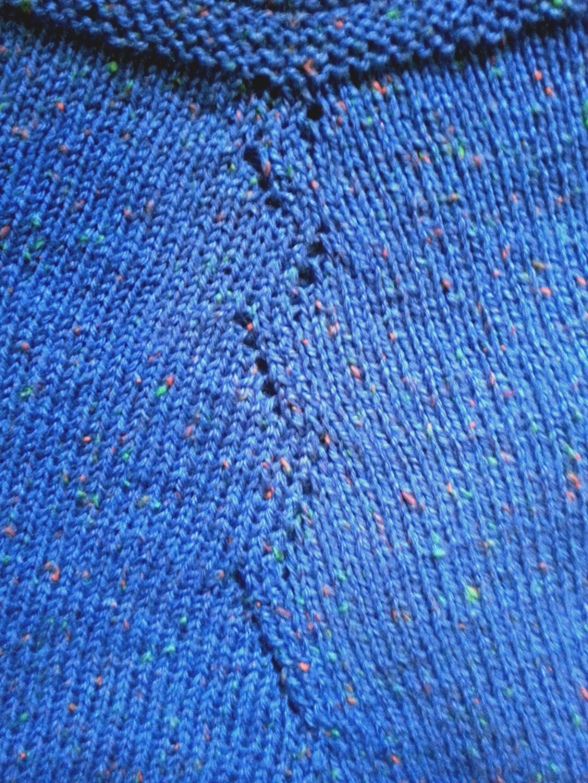
I also have the pattern written. Pat on the back again (I could get used to this). Now I have to read it over and give some serious thought to making it really easy for the knitter (that's you) to knit up (or down as it were, tee, hee).

There's quite a lot happening around the Great Divide (putting the sleeves on spare yarn and leaving the body on the needles). These are the question I have to ask:
1. Is this, as written, too much to work in one round? Can I make it any clearer?
2. Can I split it up into a couple of rounds and work the Divide in the first round and make the changes to the stitch pattern in the next round?
3. Do I need to put in exact stitch counts or can I use the Marker placements? Use both?

Do you have some thoughts for me? Do you like to work one thing at a time? Do you like one big round with lots going one so that it's done?

I only have the border of one sleeve to finish today. I'm really looking forward to wearing my new top at the Yarn Over Sleep Over retreat in a couple of weeks.
-Deb

Thursday, 30 March 2017

open M1 increase

Make one increases (M1) are very popular increases. They are worked using the horizontal bar between stitches to create an extra stitch.

My favourite one is what I call an openMake1 (oM1). I use it for raglan increases on my Top Down sweaters for several reasons:
1.  It makes a small hole (smaller than a YO).
2.  It doesn't lean to the right or left which means I can use the same increase before and after my raglan markers.
3.  Working it doesn't interrupt my knitting flow.
4.  You can read whether you have worked the increase or not.

Work an OpenM1 by inserting your Right needle from front to back, under the horizontal bar between the stitch just knit and the next stitch,
 wrap the yarn as usual to knit a stitch and pull back through. This is just like a pick up and knit.

The beauty of it is that it is just one more knit stitch in your round which you work under the horizontal bar instead of in a stitch on your needle. There's nothing more to it than that. Can you wonder that it's a favourite increase?

The trick when knitting a Top Down Pullover is to recognize, as you approach the raglan marker, whether you have worked an increase or not. A in-the-round pullover is worked with one round where the increases are worked and the next round where you usually knit. If your mind wonders like mine does, you can't always remember what round you are working on when you come to a marker. Do I need to increase or is this a knit round?

When you work the oM1 you use up the horizontal bar between stitches. It's now a stitch. So if you see this, you have worked the increase in the last round. There is no horizontal bar there.

This indicates that you are on a Knit Round. You would knit past this spot and continue knitting your round. Next time you come to this marker (in the next round), you will see a horizontal bar.
Then you work the oM1 under that horizontal bar because it's there.

In a nutshell, if the horizontal bar is there, you work a oM1, if it's not there you knit.

Enjoy,
Deb