I have cast on a new sock. It's a barter sock for some work I had done on my house. I love that I have one service I can offer in exchange.

Gray seemed a safe colour but it's occurring to me that it might be a little too safe. I'm considering restarting this in a lighter colour. I can't see the pattern as well as I would like. Hmm, this might get frogged.
Sometimes it seems that I am ripping out more than I am knitting up. That can be good if abandoned projects are going to get a new life.
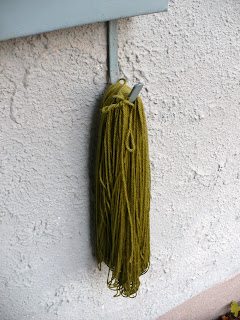
Like this green wool which was a scarf and is now going to be a second 'Last Minute Baby' sweater, after it's dry. I've written the pattern and knit one sweater. This is a quick knit on large needles for a fast last minute gift. Not fancy but cute enough I think.

I'll knit a second one in the green yarn to check all the numbers for the 3 month old size.
Here's a dilemma you can help me out with. I taught a class on Top Down knitting yesterday and I tried something different for me. I made it a project class which this stores' customers prefer. They started the little red sweater above. It's worked on 6.0mm/US10 needles with heavy worsted weight yarn and is a quick knit. Starting with the collar cast on, in a 3 hour class a knitter can get to, or close to, the underarms even with my teacher chat thrown in. That covers all the neck shaping, the increasing for the raglan lines and the divide into the body and sleeves. This is all good stuff and the class went really well.
Usually when I teach this class I have the knitters work on a miniature sweater about the size for a teddy bear. The sweater is smaller so the knitters get further along. Most of them have the sweater knit past the dividing row. With their sweaters divided into body and sleeves, they can usually get an inch of the body done and then they can get some or all of one sleeve finished.
What I would like is your comments on this:
If you were taking this class and knitting a 3 month old sized sweater for a real baby, does the fact that it's a real project interfere with the learning process?
Would you prefer to learn on a sample which doesn't have to be anything, like a half finished teddy bear sweater, or does working on a real project which you will have after you finish it, have more appeal?
Comments, anyone?
-Deb

 On the right side, close to the neckband are the holey YO's which are great increases because they are easy to see and easy to 'read'. Next are a set of closed increases (no holes) and close to the circular needle are increases which make small holes (my favourites). I hope the teddy bears that will be wearing these sweaters don't mind the change in the look of the raglan lines. I'm stopping here so that in class tomorrow I can show how the Divide for Body and Sleeve row works.
  I've packed the car with a couple of samples, printed off my class notes and set the alarm. Wait, a map. OK now . . . Go!


 Is the pattern on the back terrific or what?! It's fun to knit and I can't wait to get going on the rest. I have been searching for a yarn which would suit this design and show off all the cables. I'm really happy with how this wool worked out and today I'm going to buy enough to get going on it for real.
 This is a really quick knit. I should be able to get this finished and up on the website soon.
  And this required some work, unfortunately quite a bit of work, to replace 4 big patches of stucco.
 But now the stucco is back in place and all I have to do is paint it, if it would just stop raining.
 I go out and admire it daily.
  I also finished up my pair of 'ice chip' socks. Yes, this is a pair and I don't have another pair just like it. Just those 2, that's it. Ha, ha.
 I'm really liking the blips in this wool. I have a couple of other projects on the go too which I will reveal as soon as they gel up a bit. But I am officially back on the blog wagon again. So, see ya a little more often,


 All done. You can see that across the Back (top of the photo) you have 8 rows of knitting. At the Front edge of the sweater I have 2 rows next to the neckband. More rows across the back of the neck than at the Front edge means the Front will be lower than the Back and in this case form a V neck like in the red sweater above. Aren't short rows the most amazing things?